E-Commerce
Product Discovery Agent
Let shoppers search your catalogue the way they actually talk — and find the right product in seconds. No keyword guessing, no “no results”. It reasons over your catalogue and asks smart follow-ups.
- Live in days
- Your data stays yours
- Answers in seconds
The problem
Keyword search hides your catalogue
Customers describe what they want in plain language; your search bar matches keywords. The gap shows up as “no results”, abandoned sessions, and products people never find — even when you stock exactly what they need.
Building natural-language search in-house means expensive NLP infrastructure and a team to maintain it. For most catalogues, that never gets approved.
The fix
Search the way customers talk
A Product Discovery Agent reasons over your catalogue through MCP. Shoppers ask in their own words, and it returns the right products — asking follow-ups and comparing options like a sales assistant would.
Configure it once and drop it into your search bar or chat. No NLP pipeline to build, and your catalogue data stays in your environment.
Out of the box
Real questions, real answers. However your shoppers phrase it.
The agent interprets intent and reasons over your catalogue — so shoppers find the right product even when keywords would fail.
“Waterproof jacket under $150?”
Returns in-stock matches that fit the budget and need.
“Something for a beginner.”
Interprets intent and narrows to the right options.
“Compare these two for me.”
Lays out the differences like a sales assistant.
“What's good for cold weather?”
Reasons over specs to surface genuine fits.
“Do you have this in blue?”
Checks live variants and stock before answering.
“I don't know what I need.”
Asks smart follow-ups to guide them to a choice.
How it works
Four steps in the dashboard. The last one is a POST.
Create the agent
Add an agent, choose a model — GPT-4o, Claude, Gemini — and write a short system prompt that says what its job is. Five fields, no code.
Name
Provider
Model
Temperature
System Prompt
Connect your Catalogue API
On the agent's MCP tab, register your Catalogue API as an MCP server. SentientOne discovers the search_catalogue tool on its own, and your credentials never leave your environment.
Name
Transport
URL
Auth Type
Test it in the Playground
Ask the questions your users actually ask. The agent calls your API, reads the live response and answers in plain language. Adjust the prompt until it reads the way you want.
Go live with one request
Copy your API key and POST from your app. There is no SDK to install — anything that can make an HTTP request is already supported.
Platform API key
API endpoint
POST /v1/chat
X-Api-Key: sk-live-•••
X-Agent-Id: product-discovery-agent

{ "message": "Waterproof jacket under $150?" }
Why SentientOne
Why teams ship this with us. Instead of building it.
Ship it without an AI team
No ML hires, no prompt infrastructure, no model plumbing. You configure the agent in the dashboard — and we'll set up the MCP server that wraps your Catalogue API at no extra cost.
Your data stays in your estate
The MCP server runs on your infrastructure. SentientOne receives the tool response and nothing else — not your database, not your credentials, not your records. Self-host the whole platform if that's the requirement.
Works with the stack you have
Any REST or gRPC API connects through MCP. One HTTP endpoint covers React, Flutter, Python, .NET and Go — anything that can make a request. No SDK to adopt.
Change the model, not your code
Run GPT-4o today and Claude tomorrow by changing a dropdown. When your API changes you update one tool definition — no retraining, no redeploy.
“Customers describe what they want and the agent finds it — even things they'd never have searched for. Our 'no results' page basically disappeared.”
The outcome
What changes once it’s live.
- Fewer
- dead-end “no results” searches
- Days
- to deploy — no NLP pipeline to build
- Private
- your catalogue data stays in your environment
How long does it take to go live?
Most teams are answering real questions within days. There is no model to train and no AI pipeline to build — you connect your API and configure the agent.
Do we need AI engineers?
No. The agent is configured in the dashboard, and we'll set up the MCP server that wraps your Catalogue API at no extra cost.
Is our data safe?
The MCP server runs in your environment and returns only the specific tool response. Your database, your credentials and your raw records never reach SentientOne.
What happens with questions it can't answer?
You set the boundaries. Anything outside product search is handed to your team with the whole conversation attached, so nobody starts from scratch.
Which models can we use?
GPT-4o, Claude, Gemini, Llama, Mistral and Groq. Pick one from a dropdown and change it whenever you like — your prompts, tools and integration stay exactly as they are.
How does it reach our users?
One HTTP endpoint. Drop it into the chat widget, app or site you already run — React, Flutter, Python, .NET, Go, anything that makes a request.
Free white papers
Read the longer version.
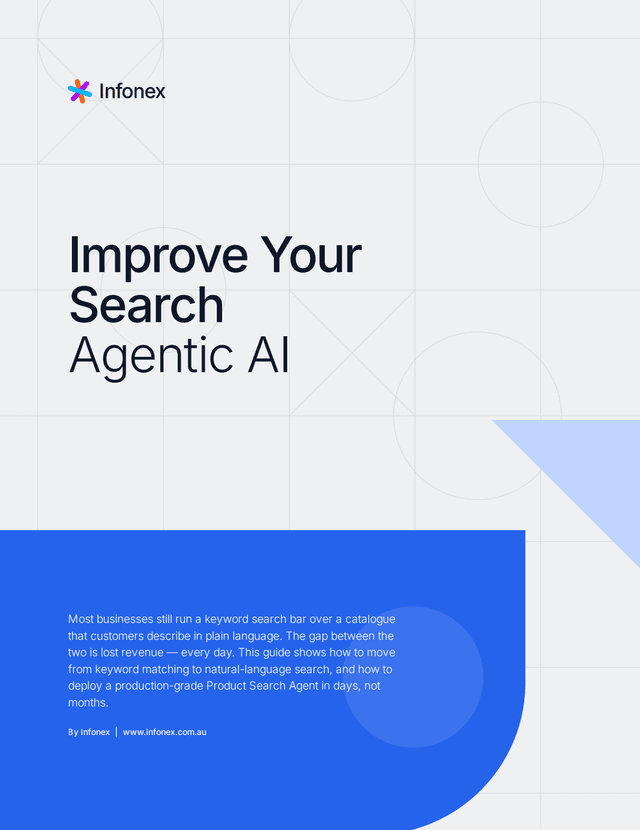
Improve Your Search with Agentic AI
Most businesses still run a keyword search bar over a catalogue that customers describe in plain language. The gap between the two is lost revenue — every day. This guide shows how to move from keyword matching to natural-language search, and how to deploy a production-grade Product Search Agent in days, not months.

Improve Your Knowledge Base with AI Agents & RAG
Your team's knowledge is scattered across docs, wikis, and tickets — and answers stay locked away until someone goes digging. This guide shows how Retrieval-Augmented Generation turns that knowledge base into an AI agent that answers in plain language, cites its sources, and stays current, so your team finds what they need in seconds instead of hours.
More patterns
Other agents teams start with.
Order Status Agent via MCP
Let customers ask about their orders in plain English.
Business Intelligence Reporting Agent
Turn your database into a conversation.
Personalised Recommendations Agent
Send insights in, get smart recommendations out.
Customer Support Automation Agent
Handle 70% of tickets before they reach your team.
Get started
Build this one first. We’ll wire up the MCP server.
Bring the API you already run. Start the trial and configure the agent yourself, or walk through it with the team that built the platform.
14 days free · No credit card · Bring your own model keys